
Outreach Activities and Livability in Contested Spaces Talk
Greetings Protecting our Futures Supporters!
We are writing with an update on our outreach activities as well as with the promised link to the Joe Pavelka talk, and a summary of our perspectives on that talk.
Outreach Activities:
Protecting our Futures has started a Voices of Canmore project where we will be asking Canmore residents their thoughts about the proposed development, what the land means to them and posting the interviews on social media. Our first voice was Bob Janes Voices of Canmore - Bob Janes. Bob does a superb job of expressing the concerns that many of us share about this development. If you are interested in adding your voice to this project, please let us know (protectingourfutures@gmail.com) and we’ll arrange to do a video.
We will also be launching a social media campaign shortly. Please visit, like and follow our pages on Facebook and Instagram.
You may have seen us on Rundleview Drive and at Quarry Lake parking area recently (Outreach at Quarry Lake Photo, courtesy of RK Media). Our goal was to organize to raise awareness of the hotel and spa proposal. The vast majority of people we spoke to were very distressed about the proposal and willing to Take Action to help preserve the green space. When weather permits, we will hold more of these personal outreach events as they are a terrific way to connect with people. If you’d like to volunteer for one of these events, please contact us at protectingourfutures@gmail.com.
Protecting our Futures has lawn signs! If you would like a lawn sign, please e-mail us at protectingourfutures@gmail.com, and we will arrange to get one to you (we’d appreciate a small donation to help us defray printing costs of approximately $10 per sign). We are particularly keen to get lawn signs up outside of Rundleview to raise awareness of the proposed hotel and spa among residents elsewhere in Canmore.
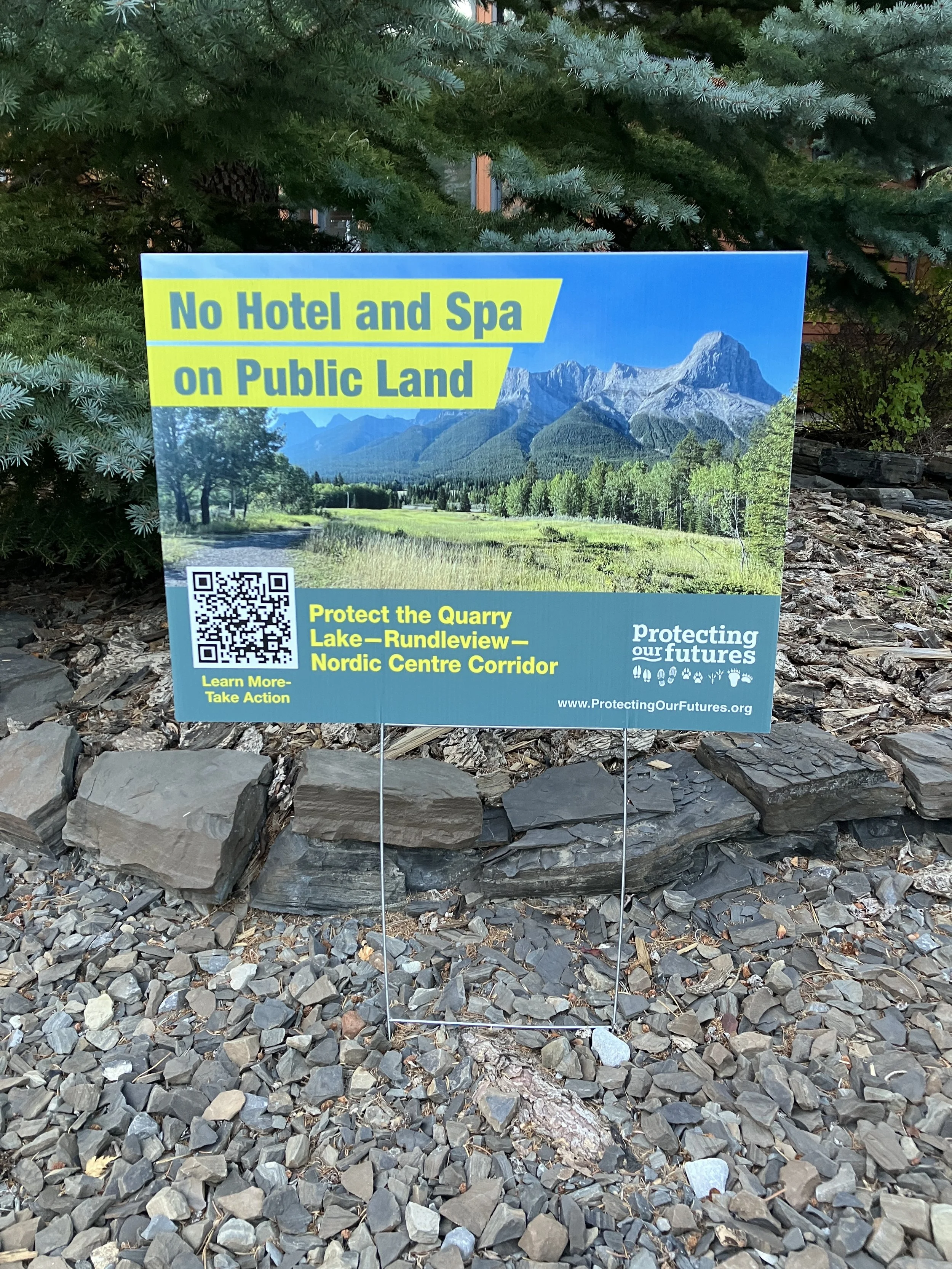
And don’t forget, we have an online petition that you can sign at Protecting our Futures Take Action!
Dr. Joe Pavelka Talk “Livability in Contested Spaces”
As promised in our last newsletter here is a link Dr. Joe Pavelka's Livability in Contested Spaces talk that we organized in June of this year. Scroll down below the video for a link to his slides as well as a timeline of the presentation contents.
Our Take on the Talk:
Protecting our Futures supporters who viewed the talk had the following key takeaways:
Canmore and Banff together form a gateway community. Banff serves primarily as a tourist centre (with tourist revenues that dwarf those of Canmore), while Canmore is a residential community.
Canmore has experienced a high level of amenity migration, with people moving here to enjoy a higher quality of life and access to natural amenities. The number of tourists visiting Canmore continues to grow, resulting in the community becoming a “contested space,” with a mix of long-time residents, new full-time residents, part-time residents, and tourists. Both increased residency and rising tourism present challenges for Canmore.
Tourism tends to be less disruptive to a community when residents and visitors occupy distinct areas, such as the Banff Avenue tourist area. In Canmore, this separation is more difficult to achieve. The tourist areas here are located along Bow Valley Trail, Spring Creek, the town centre commercial area, Silvertip resort area, and the Three Sisters Mountain Village resort area. The residential areas are the balance of Canmore. It is important that we continue to recognize these designated areas within the Municipal Development Plan rather than building in random locations such as the proposed hotel and spa development.
Protecting our Futures believes that placing a hotel and spa immediately adjacent to a residential neighbourhood is highly inappropriate. We leave it to the developers to determine if there is a viable business case for another hotel and spa in an area already designated for them, but they should not be constructed on “Community Open Space and Recreation” land.
Adverse impacts of development occur on trails, non-urban areas, backcountry regions, and wildlife habitats. As the community grows, trails and habitat get pushed outward, affecting the natural environment. And demand leads to supply; for example, the popularity of local trails attracts more hikers and bikers, which in turn increases the demand for more trails, perpetuating the cycle.
If we don’t support rational and appropriate development, the result will be less natural space and diminished wild areas. These impacts threaten the very qualities that attract people to Canmore, and we risk losing the identity of a small mountain town.
Planning should begin with a discussion about priorities, and then Canmore should build plans, policies, and infrastructure accordingly. Joe asked us to consider under what conditions increased tourism would be acceptable to us. He provided some examples of host communities’ “as long as” caveats, such as we want tourism “as long as” we can manage visitation with sustained corridors, “as long as” we can enhance the lives of those not directly involved in tourism, or “as long as” we retain more dollars (taxes) for our destination.
What is your “as long as”?